
Project Completion Date: October 31, 2025
Project Contact: April Bonise
👉 See Project Summary

Project Purpose
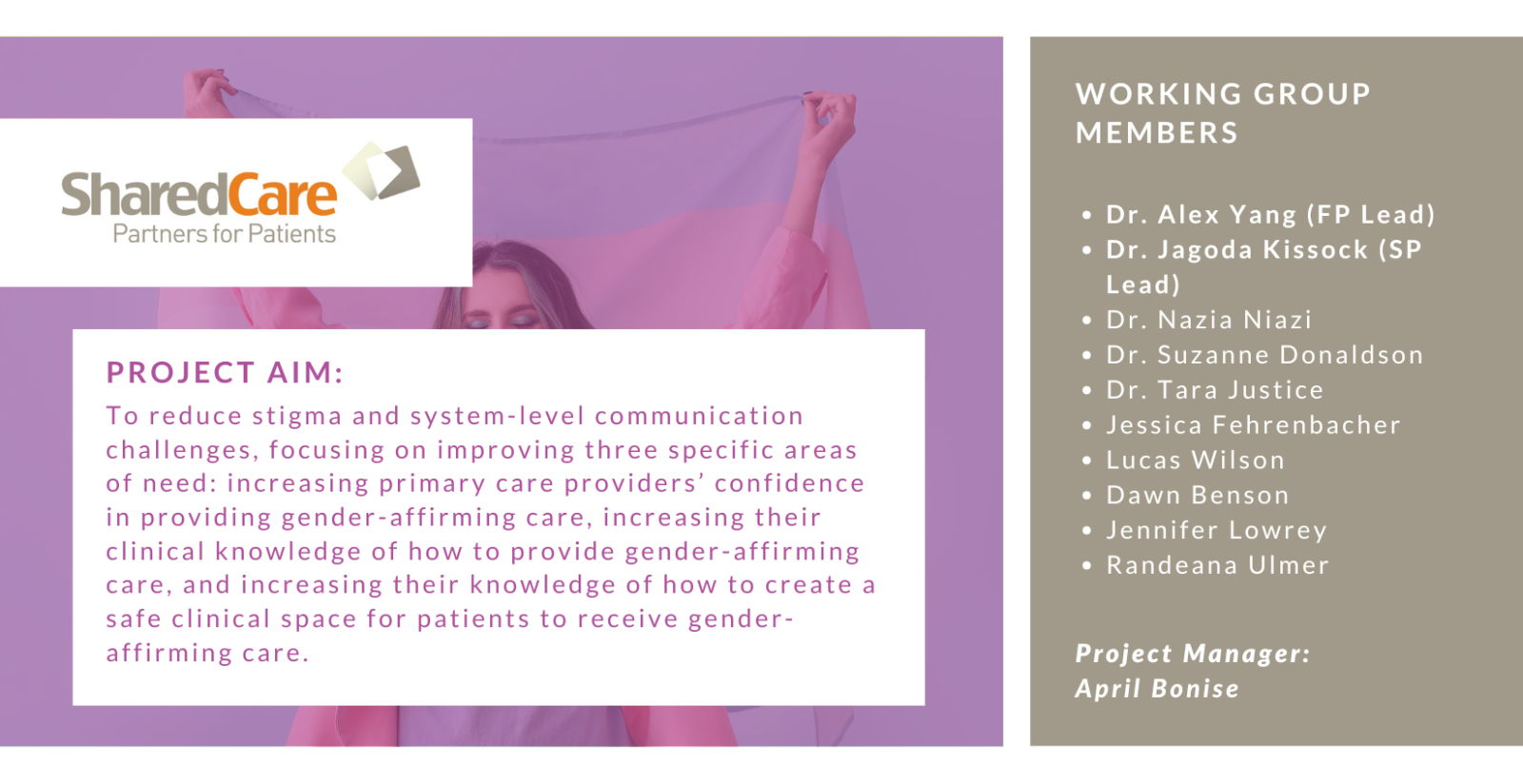
Access to gender-affirming care in primary care remains inconsistent, with gaps in provider confidence, clinical knowledge, & system navigation contributing to barriers for Two-Spirit, trans, and gender-diverse patients. A 2023 Shared Care EOI project identified unmet patient needs and limited provider training through patient & provider surveys. In response, the Surrey–North Delta Division of Family Practice implemented the Transforming Gender-Affirming Care project from May 2024 to July 2025. The project aimed to increase by 50% from baseline primary care providers’ confidence, knowledge, and capacity to create safe, affirming clinical spaces through a structured CME series & development of practical, locally-informed clinical resources
Project Methods
The Transforming Gender-Affirming Care project implemented educational interventions and resource development tools to build primary care capacity in Surrey–North Delta. The target population included family physicians, nurse practitioners, Medical Office Assistants, and Primary Care Network allied health providers, with indirect benefit to Two-Spirit, trans, and gender-diverse patients. A multidisciplinary working group and patient partners guided the work using a grace-based, “nothing about us without us” engagement approach. Interventions included a three-part Continuing Medical Education series and development of provider resources, including a locally informed care pathway. Data collection methods included session attendance tracking, pre- and post-session surveys & feedback, follow-up postcard surveys, and pathway utilization monitoring, with findings used iteratively to inform sustained learning outcomes, future session planning and resource refinement.
Project Results
The Transforming Gender-Affirming Care project engaged family physicians, nurse practitioners, MOAs, and PCN allied health providers through three CME sessions and resource development. Survey results indicated high engagement and learning: after each session, at least 79% of participants rated their interest in learning more as 4 or 5 out of 5. Follow-up surveys showed participants applied knowledge to create safer clinical spaces and improve patient support. The project reached over 70 family physician participants directly, with additional impact via recorded sessions and the Pathways BC care pathway. Qualitative feedback highlighted appreciation for patient-centered perspectives, open discussion, and practical tools to improve gender-affirming care delivery.
Project Conclusion
The project successfully increased primary care providers’ and allied staff’s knowledge, confidence, and ability to provide gender-affirming care and create safe clinical spaces. Evaluation data show improved endocrinology referrals, greater awareness of care pathways, and ongoing interest in learning. The collaborative, patient-centered approach strengthened relationships across the primary care system, supporting sustained integration of gender-affirming practices. This project serves as a foundation to normalize and embed gender-affirming care in Surrey–North Delta. Next steps include expanding training through Trans Care BC courses, supporting allied health assessments, and facilitating patient attachment, ensuring long-term, accessible care for Two-Spirit, trans, and gender-diverse patients.

 |  |  |
 |  |  |

 |  |  |
 |  |  |